WP 165 Restoration Blog

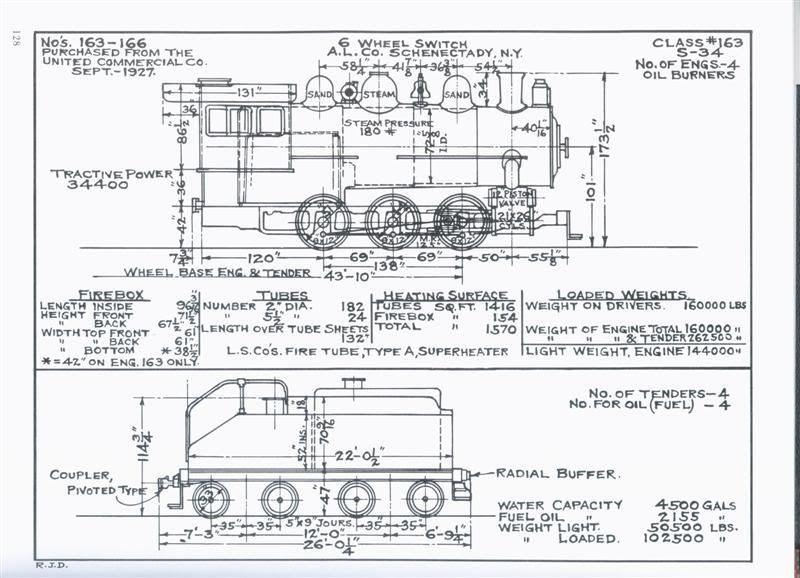
Updates on the restoration of Western Pacific 0-6-0 number 165 at the Western Pacific Railroad Museum at Portola, California.

Sunday, October 9, 2011

Fall 2011 Work Week Report

The 2011 Season for the Steam Department has ended, and we can be proud of our accomplishments over the past year. The lion’s share of the work was toward our 1472 day FRA inspection, with all but a very few of our ultrasonic thickness readings on the boiler shell completed by Nathan Osborn and James Cowdery. Nathan has also been meticulously transcribing the thickness readings into a format that is more “user friendly”.

We welcome new steam team member Dick Coudin, who I met onboard Roger Stabler’s private car “Two Rivers” on the Railroad Days Special to Portola in August. Dick met me in Woodland on Tuesday the 27th of September, and together we motored back over the hill to Portola in time to get moved into the Pullman before dinner.


Steve inspects the drivers with the D&RGW tool boxcar in the background.


Nathan takes a turn at scraping grease and paint.

A clean journal surface, ready to be polished out.

Wednesday we were joined by Steve Lee, in from Cheyenne to lend a hand and help us get through our initial FRA boiler internal inspection. The inspection was to take place on Thursday, but was cancelled Wednesday evening by the inspector for reasons beyond his control. We will reschedule in the spring of 2012, and continue on with boiler work in the meantime. Roger Stabler arrived about this time, and got to work on the base of the cab, welding up what Erin Swain had tacked in place during the summer work session. Dick drilled out for the rivets along the bottom of the sides. These will be driven into place, hopefully, in the spring. Thanks to Roger and Dick for finishing up around the base. All that remains is to patch the drip rail areas on the roof. Charlie Spikes has the cab mounting brackets pilot drilled. Those will be finished off with the magnetic base drill after the cab is in place. He has also been systematically cleaning up the driving boxes over the summer. The grease is quite stubborn, and progress is slow, but he is sticking with it. With any luck we will have them ready to lower the frame and boiler back down on the drivers by this time next year. Wednesday evening ended up with some delicious rib eye steaks grilled to perfection by Roger, a nice way to end the day.


Dick drills holes for the rivets at the base of the cab.

Thursday a twenty-thousand pound capacity forklift, sourced out by Charlie, was delivered to unload our 16” lathe from where it has been residing over the summer, in the back of the dump truck. This machine was too heavy for our beleaguered white forklift, so more power was in order. After the lathe was set in place, the next logical move was to relocate the locomotive drivers indoors where they could be cleaned and inspected for cracks, a chore the giant rented forklift handled readily, and we sent it back on its way. Our good friends from the Golden Gate Railroad Museum, Dave Roth and Severn Edmonds arrived to find us at work in the shop. Dave pitched in with Nathan and Steve on needle scaling and scraping the driver sets, and Severn set about cleaning the years of built-up scrunge on the lathe, which as he discovered, is in nice shape. Duane started the wiring, and he hopes to have it operational soon. Our thanks to the Union Pacific railroad for their donation of this machine. Steve Lee inspected each driver spoke closely, and found no cracking, which was a huge relief. Repairs to spokes can be a costly and dramatic undertaking.


Our "new" 16" lathe indoors at last!

Steve scraping grease around the hubliners.

Roger began prepping the patched area on the right side of the wrapper sheet that had been removed last season. The sheet was corroded to the point of needing replacement, so new pieces of code steel were obtained. Roger and Dick ground the new plate to fit, beveled the edges for welding, and tacked in place so we could transfer the staybolt locations for pilot drilling. The two larger patches up on the roof area of the wrapper still need to be fitted; more work for the Spring. Thursday night was dinner at the Roadhouse across the river. Thursday was a good night for dining there- no Karaoke.

Friday cleaning continued on the locomotive frame outside. This less than pleasant task was undertaken by Ed Chase, Steve Cope, and Jim Greco, who was experiencing his first day in steam restoration (and hopefully not his last!). The guys found a formerly undisclosed crack in one of the frame spreaders. This can be ground out and welded in situ due to its easily accessible location. Thanks to them for sticking with it, a good deal of the frame may now be inspected for cracking. Dick and Charlie primer painted the pilot beam and deck, as well as one of the cylinders. The 165 is starting to look like someone cares!
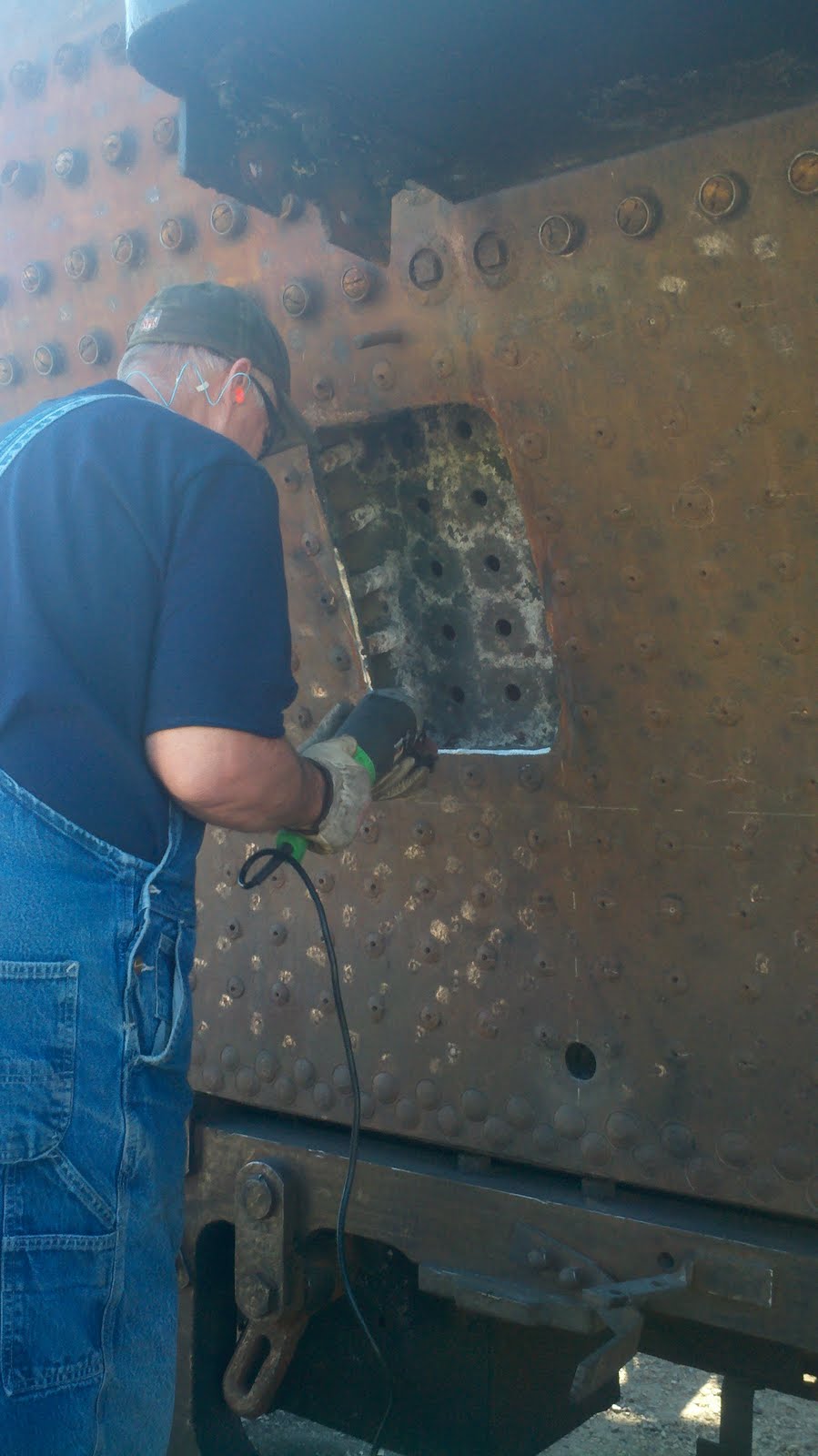


Roger preps a patch area for weld.

Severn cleaning up the lathe.

Roger and Dick forming a piece of boilerplate using heat.

The patch tacked in place and marked for drilling.

New section of steel around the base of the cab.

Friday continued with more of the same. Grease, paint removal, on and on it went. Roger’s company thought they might need him at some point, so he headed back to Woodland that evening. Thanks to him for bringing up his welding machines, and getting a good deal of work accomplished. Steve Lee was presented with the Ultrasonic thickness readings taken to date. He will be begin to generate our FRA Form 4, which is essentially a big book of stress calculations, over the winter back in Cheyenne. Given the average winter temps in Cheyenne, he should be encouraged to stay out of the wind and get a lot done. Thanks again Steve for coming out to Portola and your continued support!

Dave and Dick took preliminary UT readings on the drypipe inside the boiler, the pipe that delivers the steam from the throttle valve on one end, to the cylinder admission pipes on the other. This is simply a length of seven inch diameter pipe with fittings on each end. Readings revealed thin areas in several places. I opted for replacement, Steve concurred. Now is the time to replace this component, since the boiler is devoid of tubes, and front tube sheet is partially removed, giving easy access. If we waited until after the engine was in operation, and this pipe failed, even if nothing bad happened due to the uncontrolled acceleration, we would have to go through seven levels of Hell to get it out. Another dandy project for the spring.

All week long Bob Sims was hard at work measuring our ex-D&RGW tool car for interior build outs to outfit it as a machine shop and work area for the Steam Department. Thank you to Bob for taking this necessary project on. As I write this about half of the materials necessary are onsite. Bob will with any luck and good weather get a lot done later this year.

Saturday we winterized, tarped, and generally put things away. Another season is behind us. Sunday morning Dick and I headed down the hill and stopped into Colfax, where our Museum’s train was on display, staffed by our friendly volunteers, for the Railroad Days celebration in that town. The equipment looked shiny and spiffy, a rolling ambassador to the WPRM.

Thanks again to all of you for your continued support. Thanks also to the team behind the scenes that makes sure we keep moving forward, including Rod & Gail McClure, yardmaster Steve Habeck, treasurer James Mason who keeps us grounded, our webmaster Tom Carter, Eugene Vicknair, our graphics department and cheerleader for us from time to time, Norman Holmes who continues to donate more bits and pieces for the engine he comes across, and of course to Steve Lee, whose mentorship during this project has been invaluable. Special thanks go to Charlie Spikes who spends days getting ready for our arrival making sure everything is in place when we arrive.

Interestingly, after a gorgeous week in Portola, the weather turned just days after we left, and snow was flying again by the middle of the week. Everyone have a nice holiday season, and we will pick up where we left off next year! We will convene again at the end of April, after things thaw out a bit. - JCA

Saturday, July 30, 2011

Steam Department Summer 2011 Update

The absurdity of life never ceases to amaze me. No sooner had our sandblasting contractor finished up with the 165’s cab, the sky opened up and dumped on the freshly bared metal, turning everything a rusty orange haze by the next morning. I purposely scheduled this work at the end of June to avoid such an event, but Mother Nature had other plans for my sanity.

Roger Stabler and I traveled to Portola June 28th with the goal to prep and primer the cab prior to the July work session. Our sandblasting contractor had a few minor “mechanical difficulties” on the drive over from Reno but was still able to get going by around 11am. While he started blasting the multiple layers of cab paint away, Roger and I started removing four more leaf springs from the locomotive, which are currently being rebuilt at a spring shop in West Sacramento. Thanks to Roger for taking the lead on the leaf spring renewal!

Cab in the process of being sandblasted. Roger Stabler works on getting the leaf springs out.

My original plan was to get the cab inside the shop for painting as soon as it was blasted. Unfortunately, as you read above, that effort turned out to be futile so Roger and I called it a day. I cursed the rain all night from inside the motel room, which was about all I could do at the time.

June 29th dawned gloriously sunny, almost like nature was mocking me. Roger, undaunted, went back to the paint lockers in the shop and found some rust converter solution left over from a prior project. After a good dousing of the stuff, the orange haze disappeared. We were now ready to paint. Roger and better living through chemicals saves the day again!

No fewer than five paint guns tried and failed to atomize the two part epoxy primer. Finally Charlie Spikes made a run over to the local auto parts store and purchased a fifty-dollar el-cheapo gun, and it carried Roger through the rest of the job. The cab and Roger were now a nifty oxide-red color. We were ready to start replacing the “cancer” or rusted metal later in July. The contractor returned for a second day of blasting, this time in the boiler interior. A great deal of scale was removed, and we are now ready for our initial interior inspection by the FRA later in the season

Back to Sacramento with a bed load of leaf springs, the extra weight yielding a very smooth ride down I-80. Thanks again to Roger for taking time off from work so we could keep on schedule.

Roger applies rust converter solution to the cab.

Primer is applied.

Cab finish primered, ready to go inside.

Fast forward to July 21st. Portola’s own “prodigal son”, Erin Swain arrives to take the lead on the weekend’s task of repairing and replacing some badly rusted spots on the cab. Charlie had previously picked up some sheared 10 gauge steel in Reno and had it ready to go by the time we got in. Thanks Charlie! The first task Thursday was to move the cab into the shop, not only to get us out of the sun but so that we could use the concrete floor to achieve flatness around the bottom, which was the completely rusted away.

Erin’s plasma cutting machine made quick work of removing the offending sections, and new pieces were tacked in place a little at a time, so as not to warp the sheet metal due to excessive heat. Burr Wilson and his son Alex helped out Erin by removing the drip rail piece on the right side, exposing more than a bit of rusted-through roof section. Removing this piece of angle iron involved drilling out a bunch of rivets holding it, then driving them out; a tedious task to say the least. Thanks to the Wilson’s for sticking with it! A big thanks to Erin for making the drive from Flagstaff, Arizona to help out. We hope to see him again soon. Erin also recently rebuilt the power reverse for the 165, which he brought back working like its brand new. Here's a video of it working after restoration. It was a complete mess when he took it home last year, and it is nothing short of miraculous how he brought it back to operation. Great job Erin! Now get on that cab woodwork! (Just kidding- Take your time, we’ve got until Spring 2014).

Erin Swain (below) and Burr Wilson (on ladder) removing rusted portions of the cab. Rust under a removed section of the drip rail. Erin working with a grinder- removing a corner section. Patches in the cab front tacked in place. In the meantime, Charlie and his son Eric started ripping out shelves in our second parts boxcar in an effort to get things organized. A huge quantity of lumber was removed, and we hope to replace the old rickety shelves with some nice new steel shelving, donations gladly accepted! Working in a steel boxcar in the July sun is no pleasant task. Thanks to those two for getting the job done. Charlie has also been cleaning up driving boxes and pedestal binders in preparation for re-wheeling the locomotive next season. A lot still needs to be accomplished, notably cleaning and inspection of the frame, but we are on our way. Ed Chase did a few hours of sweeping in the boiler removing some sandblast sand on Saturday after operations. Thanks for pitching in! Rod McClure assisted us in getting the driver sets closer to the shop so they could be cleaned. He is the only person I know who can move a set of 6000 pound drivers with a 5000 pound capacity forklift. Of course we had to use some "creative" counterbalancing to keep the back wheels on the ground, that involved just about everyone on the property at the time. Very dramatic but we got it done!

Nathan Osborn and James Cowdery will continue with the ultrasonic readings on the boiler sheets in August. We should be able to wrap up this job by the Fall work session and get the FRA form 4 underway. With any luck we will also be able to start welding the patches into the wrapper sheet at that time. New flexible staybolt sleeves and caps for the patched areas have been completed by the Strasburg Railroad in Pennsylvania, and should be in our hands by the time you read this.

Our next session is Thursday, September 29th - Saturday October 1st. This promises to be a productive and dare I say, “fun” time coming up, so we hope to see many of you in attendance. There is no shortage of work at all levels of expertise, so come up to Portola and join us!

I am quite excited that I will, for the first time, be arriving in Portola by rail for Railroad Days 2011, being held August 20th-21st. A chartered train of private cars will arrive Friday the 19th, coming out of Oakland, including car “Two Rivers” owned and operated by our own Roger Stabler. There may still be a couple of spots available on this car, email Roger Colton: pullman@privatecarservice.net for more info and pricing. I am really looking forward to finally riding in style up the Feather River Canyon, something else I can cross off my bucket list.

Another item of note: We will be starting our next fundraiser in a few weeks to raise cash for the purchase of the superheater flues. Look for details soon! Until then, have a great summer! - JCA

Monday, May 9, 2011

Spring 2011 Work Week Report

All photos by Debra Baer unless noted. (Thanks Debra!)

Spring has sprung, an unusually long, wet winter is over, and we are ready to get back to work on the WP 165. Leaving Los Angeles for a few days seldom requires an excuse, but in this case the cabin fever made it imperative. I arrived in Portola on Wednesday, April 27th ready to get something accomplished. Upon arrival we met up with Steve Lee, recently retired from the Union Pacific Steam Department. Steve came out from Cheyenne to help out for the week, and we were very happy to see him on the property. In anticipation for the “big pick” the following Saturday, Rod McClure, Steve Habeck, and Cody Wilson were adjusting the drum brakes in derrick 37, a beastly machine. Built for the WP as a steam derrick, it was converted to internal combustion sometime in the 1970’s. We ordered pizza in, and called it a night.

Thursday morning dawned clear, cold and windy. Breakfast at the Station Café with Charlie Spikes is always a good way to start the day. Charlie, Bill and Duane had spent the previous week getting our parts cleaning tank cleared away and functional so we could start degreasing locomotive parts. A 55 gallon drum of the cleaning solvent only gave us a few inches in the bottom due to the tanks enormous size, more is on order.

The big task facing us on Thursday was getting the pedestal binders ready to come off. This proved to be another colossal task given the amount of crud clogging the holes, damaged studs, etc. Luckily by this time our friends from the Golden Gate Railroad Museum in San Francisco were starting to arrive. Dave Roth, Dave Varley, Jim Prettyleaf, and Severen Edmonds were ready to get dirty, so they were put to work. By Friday Roger Stabler and Dave Wallace also took turns in the pit “persuading” the heavy binders to move, which eventually did. Everything does, in time, bend to our will, some things just not that easily. Bruce Hilliard serenaded us with the needlescaler. Charlie had to run back to Reno to refill the O2 bottles. David Hensarling, president of GGRM, arrived on Friday to check things out, and was put to work reassembling the left side brake cylinder with Jim P. and Nathan Osborn. James Cowdery, "Burr" Wilson and Nathan applied red primer to the first two boiler courses and the dome, which was nice to see, much better than rust colored metal. Doyle McCormack came down from Portland, Oregon to check out his sleeper car, the ”Magnolia Grove”, and visit with Steve Lee. Doyle is a steam veteran and has a lot of good advice for us. Thus started the “Fog of War” period when things were happening so fast that it’s hard to recount everything, so forgive me if I omit any details.


Steve Lee helps to secure a lathe donated by the UPRR for movement into the shop.


The lathe is loaded into the dump truck.

Steve Lee and Doyle McCormack join forces to rig a spreader bar.

The Derrick's master, Rod McClure.

Phil checks the rigging on the Tidewater car prior to a lift.

Friday also saw the Brehm’s up from Phoenix to re-roof the Steam Department’s tool car, the former Denver & Rio Grande boxcar donated to us by the Western Railway Museum in Rio Vista, CA. The three of them set to removing the mostly rotted T&G and recovering with plywood and rubberized roofing. This is a temporary measure until we can mill up the proper wood roofing, but at least the interior can stay dry for the time being. Thanks to you guys for making the trip and getting the job done!

Friday night dinner at the Roadhouse was enjoyable, at least until the Karaoke started. At that point we were ready to get back to our bunks to rest up for Saturday, which proved to be eventful.

Nathan Osborn and James Cowdery prep and paint the boiler shell.

Jim Prettyleaf, GGRM welder removes a wasted section of the 165 wrapper sheet.

Mike Brehm, of Phoenix, AZ after nailing down the new roof on the tool car-JCA photo.


Dave Roth, GGRM Operations Manager, assumes the "Put down the camera and get back to work" pose.-JCA photo

Saturday morning the derrick crew, guided by rigging foreman Phil Schmierer had the Tidewater Southern bunk car back up on trucks for the first time in a long time. The plan was to pick the 165 off its drivers and place the boiler and chassis in the spot previously occupied the TS car. With the binder nuts loose, and the engine back down on the axles and lubricated with some STP (Doyle’s suggestion) it left the confines of the shop for the first time in several years and was back out in the light of day. The move went slowly due to having to pull it out with a chain, before the switch crew could run around and use the coupler on the front. Finally spotted next to the derrick, Steve Lee and Phil rigged the cables, and derrick operator Rod eased the engine skyward, just a bit. Of course the 165 didn’t give up that easy, as Severen, Dave Varley and Dave Wallace had to beat on a couple of the binders before they finally gave in (the binders, not the Severen, Dave and Dave). Once Phil was confident that the rigging was sound, up went the boiler and frame, and as according to plan, the driver sets stayed on the ground, thankfully. With two taglines and numerous holders-on, the engine spinning around 180 degrees to its resting spot resembled a Macy’s Thanksgiving Parade balloon, albeit an incredibly ungainly one. After some careful negotiation through the air, the chassis and frame were set down on cribbing. Sandblasting can now commence later in the season on the boiler interior, on the drivers, and other parts. Roger Stabler has offered to get quotes on the four leaf springs that need renewal. The plan calls for re-wheeling the locomotive this time next year, barring any “unforeseen” events or disclosures once we get the numerous layers of paint and grime off.


The 165 being lowered onto the cribbing. - Dave Roth photo.


The boiler and chassis set, ready for sandblasting. - JCA photo

Thanks to all for a great deal of time, effort, and professionalism during this process. It is my hope that this is as far as we need to go for disassembly, and we can now begin putting it all back together. Erin Swain has been making good progress on restoring the power reverse cylinder at his home shop in Flagstaff, AZ. This is one example of how things are always happening on the 165 project, little by little. In time lots of littles add up to a whole lot.

Our next work session is coming up July 21st-23rd, 2011. By then we hope to have the sandblasting done, including the cab. Erin is going to lead the project to repair the cancer around the base, and renew the wood headliner. Cleaning of parts continues, thanks to Charlie and his son Eric. Thanks go to Rod McClure especially for all the prep work getting the derrick back into fighting shape. Big thanks also to James Mason, our Treasurer, behind the scenes directing all of the steam funds in the right direction. The amount of work left is staggering, but if we have a few more sessions like this last one, some real progress will be apparent real soon. - JCA