The following are the WPRM Steam Dept. work session dates for 2009:
April 16th-19th
July 28th-August 1st
October 22nd-24th
As always please RSVP to me: wpsteam@wplives.org or the Museum Manager at(530)832-4131 if you would like to take advantage of the accomodations in the Pullman Car. Together we accomplished a great deal in 2008, so let's keep up the momentum and get even more done in 2009! -JCA

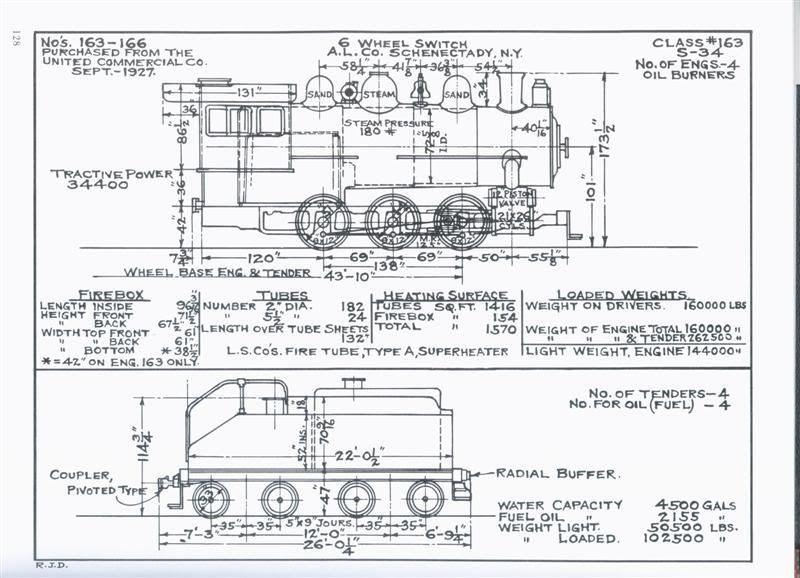
Updates on the restoration of Western Pacific 0-6-0 number 165 at the Western Pacific Railroad Museum at Portola, California.
Monday, September 29, 2008
Monday, September 1, 2008
A Glimpse into the Past II

The above view taken by George Manley in 1959 shows the WP 165 and 94 in stationary boiler service at a cannery in Escalon, California. This is likely the last time the 165 was steamed. Note the main rods have been dropped to prevent the locomotive from inadvertantly trying to leave should the throttle or the drypipe develop a leak. The track adjancent to the locomotives was the mainline of the Tidewater Southern, a former electric interurban railway, then a subsidiary of the Western Pacific.
 Another of George's photos shows the WP 94 providing steam to the cannery. If you look closely you can just make out the lettering on the tender which reads: "Watertown and Eastern R.R.". This fictious railroad name was applied for the engine's appearance in the 1960 Disney film "Pollyanna". Filming took place on the Southern Pacific's Napa Branch.
Thanks again to George Manley for allowing us to post these great photos! -JCA

Saturday, August 9, 2008
Summer 2008 Workweek Report
Monday, July 28th- Predawn 04:30 in Los Angeles is a commuters dream. Most of the time at least. Lucky for me I got to the Grapevine at full speed and made my escape toward the north and onto my first stop, Sacramento. I had breakfast with my pal from the old days, Paul Zaborsky, at a nice little bistro near his four-square Victorian downtown. We talked a little business, then about his upcoming nuptials and all the craziness involved with wedding planning, even at our age. Congratulations to Paul and Linda, I hope they have a long and happy life together.
Onto the gas stop at the Rocklin Sam’s Club, and the assault on Donner. Arrival at the Museum was around 15:30. Nathan Osborn had arrived earlier in the day, and was busy preparing for the thickness mapping of the boiler shell. Thanks to Yardmaster Steve the 165 was in position on track one. After checking in and moving into the Pullman, dinner was at the Mexican place in town, not too remarkable, but the Margarita was refreshing.
Charlie had coffee ready Tuesday morning by the time I woke up. Gotta love that! For the next two days it would be just the three of us. We accomplished quite a bit in that time, including removing the front sand dome using the devil’s own air hoist on track one. The hoist lived up to its reputation again by blowing a hose fitting and scaring Nathan quite completely. Luckily he had his hand on the shutoff valve the whole time I was operating the thing, so he was out of the way of the resulting backlash. Charlie spent the rest of the day cutting the 5 ½” flues in half so we could pass them out through the steam dome. He was really happy that we acquired the Porta-band; doing this job in such close quarters with a torch would have been miserable. All but three were removed by the end of the day. Enough was enough, so we retired to the deck and I cooked up some burgers which due to a small miscalculation on my part ended up being the size of my head. No one complained in any event.
Onto the gas stop at the Rocklin Sam’s Club, and the assault on Donner. Arrival at the Museum was around 15:30. Nathan Osborn had arrived earlier in the day, and was busy preparing for the thickness mapping of the boiler shell. Thanks to Yardmaster Steve the 165 was in position on track one. After checking in and moving into the Pullman, dinner was at the Mexican place in town, not too remarkable, but the Margarita was refreshing.
Charlie had coffee ready Tuesday morning by the time I woke up. Gotta love that! For the next two days it would be just the three of us. We accomplished quite a bit in that time, including removing the front sand dome using the devil’s own air hoist on track one. The hoist lived up to its reputation again by blowing a hose fitting and scaring Nathan quite completely. Luckily he had his hand on the shutoff valve the whole time I was operating the thing, so he was out of the way of the resulting backlash. Charlie spent the rest of the day cutting the 5 ½” flues in half so we could pass them out through the steam dome. He was really happy that we acquired the Porta-band; doing this job in such close quarters with a torch would have been miserable. All but three were removed by the end of the day. Enough was enough, so we retired to the deck and I cooked up some burgers which due to a small miscalculation on my part ended up being the size of my head. No one complained in any event.

Wednesday we hit the ground running and removed the remaining flues in short order. Nathan found an empty 55 gallon drum and we started bucketing the scale and detritus from the bottom of the boiler barrel. About a drum and a half was hauled out, 5 gallons at a time. No unrepairable conditions were found in the boiler’s belly and subsequent test readings with the Ultrasound tester confirmed that there was only a minor amount of wastage. Another testament to the Western Pacific’s exceptional maintenance and the pride the shop crews took in their locomotives. Later we managed to remove the cross compound pump, and got it put away for restoration at a later date. Wednesday was Nathan’s night to cook dinner, so we wound up at the Chinese restaurant, again with too much food.
Dana Greely and Craig Ferguson arrived sometime around 02:00 Thursday morning. I was a bit restless until they arrived, but thankfully they made it safe and sound. We all crashed for a few more hours and accepted our scolding from Charlie for getting up so late. James Cowdry also arrived on Thursday and immediately began wire brushing and needlescaling the barrel belly exterior. Not the most fun job in locomotive restoration, but fun is where you find it I suppose. Nathan began re-gridding the top halves of the first and second courses, and got set up with the laptop and the tester. Previously he wrote a program to accept the tester’s input directly into the laptop, which will save a great deal of time in the long run. When complete, we will have a map of the whole boiler with sheet thicknesses at regular intervals. We will use this data when we develop the required Federal Railroad Administration Form 4, which calculates stresses on sheets, rivet seams, staybolts, etc. From this document we will be able to obtain our Maximum Allowed Working Pressure, or MAWP.

 James and Nathan entering thickness readings into the laptop.
 Dana and Craig began a wash on Sacramento Northern Railway locomotive 712. Craig was the person responsible for writing the letter to the Union Pacific Railroad asking for its donation to the Western Railway Museum at Rio Vista. This engine was acquired by WPRM in a trade with WRM, so it’s now in Portola. Through some amount of prodding and shameless guilt-based manipulation, Dana persuaded Craig to come up and perform some clean up on this locomotive. We are all three former Rio Vista volunteers, and it does our hearts good to see this old beast looking good again, even if it’s a diesel. Thanks to Craig and Dana for the sprucing up. Thanks also to Charlie and David for positioning the 712 where it could be worked on outside the shop. Thursday evening’s dining was a sausage fest provided by Dana, and it really hit the spot.


Kenneth clearing telltale holes in the rigid stays.
We were planning on beating our retreat on Sunday morning, so Saturday we pulled the 165 outside and gave the shop floor a sweeping, collected up the tools, and gave the engine its first boiler wash since the 1950’s. Ed Chase joined us for some fun, and loads of scale were pulled out, and a good deal remains. For a first wash it was productive. After cleaning ourselves up a bit we headed over to pizza, and James treated us to another large feast, and several pitchers of brew. After the Board of Directors meeting that evening I was able to visit a bit with my old pals Rod and Gail McClure, President Director and Director, respectively, and Eugene Vicnair, who just came from Eric’s Stevens’ memorial service. Among other things, we discussed where Eric’s ashes are going to ride in the 165. During the week we hoisted more than a few bottles to Eric’s memory.


Tuesday, July 22, 2008
Eric's Spirit lives on aboard the 165.

Long time WPRM member Eric Stephens, ardent supporter of the 165 project, and friend to many, lost his battle with cancer at 9:10PM on July 17th.
Although I never personally had the honor of meeting Eric, I know that he embodied the "WP Spirit" that we hope to perpetuate in everything we do. His work ethic at the Museum and the bravery he possessed in life are an inspiration to us.
I am dedicating the Summer Steam work session July 29th - Aug. 3rd to Eric's memory. We know that from now on Eric will ride with us in his rightful place aboard the 165. - JCA
Thursday, June 19, 2008
A Glimpse into the Past

This scanned slide from the FRRS Collection shows our locomotive number 165 at Stockton, California sometime in the mid 1950's. It is on one of the "garden tracks" off the Stockton roundhouse turntable, most likely in storage after being retired in favor of diesel power. WP #909 A&B, a comparatively new set of General Motors FT series road power, is keeping 165 company, along with Tidewater Southern 70-ton General Electric switcher #742 in the last roundhouse stall. Lima built GS-64 class steam locomotive #486, now also obsolete after less than a decade of service, is coupled to the front pilot of our engine.
Today only the 165 survives. - JCA
Thursday, April 17, 2008
Spring 2008 Workweek Report
Wednesday, April the Ninth, 04:30. We piled into the truck and set off into the early morning darkness on another adventure to Portola. A requisite stop at Harris Ranch on Interstate 5 in Coalinga for breakfast assuaged our hunger. Rita met with one of her Caltrans associates in the parking lot to drop off some course materials and we were off again. Next stop at the Redwood Valley Railway in Berkeley to drop off our 15” gauge caboose for meet in June. Then onto another Caltrans office to drop more course materials, then to my folks place in Concord for lunch. There we met up with Steam Team member Dana Greeley who would accompany us up the mountain. After a stop at Sam’s Club in Rocklin for food and fuel, and the last of the burdensome course materials delivered, we struck out for Portola. Hunger was again upon us when we pulled into town; consequently our first stop was the Hong Kong Chinese diner. After we ingested way too much food, we arrived onto the property around 16:30. Owing to the lack of a million streetlamps in Portola it was much darker than when we left LA.

Thursday, April the Tenth. The morning dawned quite chilly, around 18 degrees (F). Our old friend and Steam Team member Charlie Spikes was on hand to let us know that the remainder of the week would be warmer. Those words didn’t help much right at that moment, but they were true. Luckily Charlie and Steve spotted the locomotive outside the day before which was good given the sooty nature of the work at hand. Working in the sun was also beneficial. After breakfast in town with the family I suited up and prepared to blow that troublesome soot forward into the smokebox. Dana set out to access our welding gas situation. Expecting at least one set of full bottles, those expectations were dashed when we learned that all bottles were empty save two that were all but depleted. Resigned to working with what we had on hand, the remainder of the empty bottles were loaded into Charlie’s truck to be refilled in Reno the next morning. Despite our limited resources, Dana and Charlie managed to remove around 50 of the 2” diameter tubes before completely running out of gas, literally and figuratively. All I managed to do was turn myself into a big sooty mess. Our dog Missy, who was tied up too close to the engine, looked like a big furry black flue brush. A dinner of hamburgers and sooty buns, a scrub down in the shower car with the accursed orange cleaner, a shot of single malt, and off to bed.
 Roger Stabler cutting tubes on the rear tube sheet.
Friday, April the Eleventh. Having settled into our new surroundings, and acclimating to the elevation, our group actually got a fair amount of sleep Thursday night. The temperature outside was a tad less biting than the morning previous. I ventured over to the mini-mart at the gas station to get coffee; I brought an extra one over for Dana who was slumming in the break room. After Charlie arrived from Reno with a truck full of fresh cylinders (hussah!) Dana was back into the firebox to continue the job. The loan of a straight cutting torch from Paul Boschan made the job a lot easier. In many cases there is not enough room to cut using a torch with a ninety-degree head. We are grateful to Paul for his continued generosity. Rita and the girls left in the truck after Breakfast to go explore Boomtown on the Cal/Neva border. I considered her choice of routing suspect, but I gave it nary a thought. That was until about lunchtime when I got a panicky call on my cell, barely audible, that they somehow got the truck stuck in the snow way above Loyalton on some backcountry almost-road. Roger Stabler arrived at that precise moment, and being the good sport that he is agreed to help with the rescue. Striking off to Loyalton in Roger’s truck, we collected my family at a picnic area approximately 5 miles from where the truck was mired. They had to walk out that far to get a cell signal, most of the way back into town. The Stabler 4WD pulled out our 2WD truck handily, and we hauled an exhausted yet grateful bunch of girls back to Portola, their curtailed adventure now complete.

Pulling out the stuck truck in the high country.
Upon our arrival back at the Museum, two new members of the Steam Team, Nathan and James, were already hard at work wire brushing the boiler shell exterior, which they did with gusto. Two cutting torches were now in use, one at each tube sheet. Three pallets of the 2” tubes were loaded, and the 5 ½” superheater flues could now be attacked. A few of these larger flues were cut down, and most of us broke for dinner. Dana worked tirelessly in the firebox right up to when his steak was ready. The rest of us slaked our thirst with Newcastle Ale provided by Roger. We felt guilty that Dana was still working, but the heady UK brew helped us get over it. Sorry Dana!

Dirty Dana after a day in the firebox.
Saturday, April the Twelfth. This was the last full workday before heading home, and I vowed to have the boiler devoid of tubes and flues before we tied up. Roger, Dana and Charlie took this to heart and by the end of the day the tubesheets were clean. I give kudos to those guys for seeing it through to the end. The flues remain to be cut up into short enough pieces to be passed through the steam dome, but they are down, that was the goal and they met it, by gaud. Nathan and James started the arduous chore of drawing grids on the boiler for thickness mapping with Roger’s Ultrasound tester. Zillions of thickness readings will be taken so that we can ultimately determine the eventual boiler pressure allowed under FRA rules. These guys are going to take this to a whole new level, thanks to their software backgrounds. Nathan is also going to draw the boiler into CAD format, which is also a big job, and no less important. Thanks guys!

Charlie taking a turn at cutting tubes.
During the day I took the opportunity to inspect the new (to us) components donated by a rich uncle. The items include a complete #11 injector, which we will use on the right side, a NOS Nathan hydrostatic lubricator, a throttle lever to replace the purloined one, and gauges, which, after a rebuilding, will be quite shiny. Thanks again to our rich uncle, you know who you are. Another surprise this day was a call from our benevolent leader, Rod McClure, who informed me that one of the tender heralds from this engine, stolen years earlier, had been returned during the WP Convention that was happening in Sacramento. This “prodigal” tender insignia will again grace the side of the locomotive, thanks to FRRS member Vic Neves who located it and arranged for it’s return.

The donated throttle lever is checked for fit - that's me happy if you can believe it.
Our wrap-up dinner was again in town at the Pizza Factory, and thanks again to Roger’s generosity (hussah!), we enjoyed pitchers of our official crew brew, Fat Tire Ale, on tap, thank you very much. The pizza was about the size of an excavator tire, and there was a lot left over for Charlie, who hopefully found the leftovers in the shower car fridge.

Rust and corrosion on one of the removed tubes.
Sunday morning, April the Thirteenth, 07:30. Rita was up packing even before I woke up. At 09:30 we said our goodbyes and headed out the gate. Back to Concord to reunite Dana with his car, spend some quality time with the folks, siblings, and cousins, etc. and continue south. LA greeted us with intolerable traffic when we got in around 20:00, but we pushed through. Home was a fine site. Missy was so happy to be home she rolled around on the carpet, which is now about as sooty as she was. Go figure. - JCA
.jpg)
Sunday, February 24, 2008
Thanks to Our Donors.
Time to single out a couple of outstanding donors to the WPRM's 165 project.


First, our grateful thanks to Paul Boschan of Boschan Boiler in Carson, California.
Paul donated 120 feet of one inch diameter staybolt stock- accompanied by the MTRs (Mill Test Reports) which allows us to use it as code material in a pressure vessel, in our case, the 165's boiler. Believe me when I say that code material ain't cheap!
Paul's ongoing generosity has also been extended to including access to his shop for various restoration projects, such as the 165 headlights.
Another one of our key donors is Roger Stabler, of Woodland, California. Not only has Roger donated to the 165 monetarily, but he has been a valued volunteer on site, and never leaves until his goal is met.
Here you can see Roger removing the nozzle casting from the 165:
Unfortunately the above pic is the best view I have of Roger, but that just illustrates the fact that Roger likes to keep his nose to the grindstone, so to speak. Roger is also in the process of being certified as our pressure vessel welder. This will allow us to perform our own repairs, saving untold thousands of dollars.
Individuals like Paul and Roger are rare, to say the least. We are lucky to have them both helping us out. Our thanks may not be enough in some cases, but hopefully they know how much of a difference they are making in the railroad preservation field, as well as helping to keep the Western Pacific legacy alive.

Now if that damned snow would melt we could get back to work! - JCA
Subscribe to:
Posts (Atom)